Ultimate Bet permits
Thursday, May 8, 2008
Ultimate Bet

Tuesday, February 27, 2007
New Google Mini Integrates Google Analytics
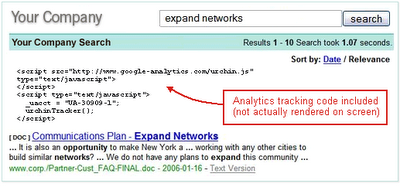
Google's enterprise team has just released an update to the Google Mini that features integration with Google Analytics. The Google Mini is a hardware and software solution that businesses use to search internal corporate data, as well as public websites. By adding integration with Google Analytics, the Mini just became an even better solution for searching public websites. By adding Analytics tracking code into the search results, the Mini's administrator can understand what visitors are searching for and whether searchers are able to find the information they need. Previously Mini owners had to manually customize their search results to include tracking code, and the new integration makes this process much easier.
To configure a Google Mini to use Google Analytics, an admin need only set the Google Analytics account number inside of the Mini's administrative interface. The output format of the search results will automatically include the JavaScript that Google Analytics uses to study a user's navigation across your website.
Learn more about the mini and Google's enterprise search solutions, and buy the mini at the Google Store.
To configure a Google Mini to use Google Analytics, an admin need only set the Google Analytics account number inside of the Mini's administrative interface. The output format of the search results will automatically include the JavaScript that Google Analytics uses to study a user's navigation across your website.

Learn more about the mini and Google's enterprise search solutions, and buy the mini at the Google Store.
Fun in the Google Analytics Forum
Have you ever needed some quick advice about using Google Analytics, or wanted to learn some cool tricks? The Analytics Help Forum in Google Groups is a great place to go to see people helping out their peers by asking for, and quickly sharing, best practices, references, advice, and observations.
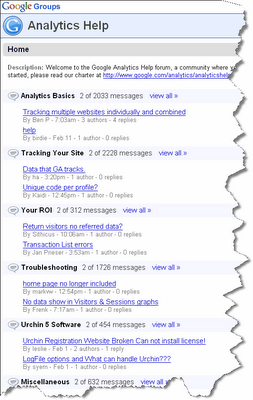
There are six discussion sections: Analytics Basics , Tracking Your Site , Your ROI, Troubleshooting, Urchin 5 Software, and Miscellaneous, each with a good number of interesting contributions.
For example, in this helpful discussion thread user 'MercuryTide' asks, "Does anyone know if it is possible to have tracking report to 2 different GA accounts?" User 'ShoreTel' and user 'bac' reply that this can be accomplished by resetting the _uff flag, each giving a different method of doing so.
And sometimes experienced users will answer a request for tips on more than just troubleshooting Google Analytics. In another discussion thread , user 'agapit' says, "I have just changed a site design and layout. I have not changed any marketing parameters. Bounce rate went down from 62% on home page to 49%. What proven design suggestions that lower Bounce Rates are there?"
'Caleb @ Pop,' an experienced Google Analytics Authorized Consultant, replies, "The most important thing to keeping bounce rate low is giving the visitor what they want to find right away." He goes on to give a helpful example of the path from ad click to conversion, citing that when possible, the landing pages should be customized to contain the converting action mentioned in the ad or link. And he recommends linking to a specific product page when advertising that product, rather than linking to the home page which would require some navigation by the visitor.
For lively discussion about Google Analytics, visit our Google Group. You can ask for answers to your questions, contribute your own knowledge, or just read through the different discussion threads to learn more.

There are six discussion sections: Analytics Basics , Tracking Your Site , Your ROI, Troubleshooting, Urchin 5 Software, and Miscellaneous, each with a good number of interesting contributions.
For example, in this helpful discussion thread user 'MercuryTide' asks, "Does anyone know if it is possible to have tracking report to 2 different GA accounts?" User 'ShoreTel' and user 'bac' reply that this can be accomplished by resetting the _uff flag, each giving a different method of doing so.
And sometimes experienced users will answer a request for tips on more than just troubleshooting Google Analytics. In another discussion thread , user 'agapit' says, "I have just changed a site design and layout. I have not changed any marketing parameters. Bounce rate went down from 62% on home page to 49%. What proven design suggestions that lower Bounce Rates are there?"
'Caleb @ Pop,' an experienced Google Analytics Authorized Consultant, replies, "The most important thing to keeping bounce rate low is giving the visitor what they want to find right away." He goes on to give a helpful example of the path from ad click to conversion, citing that when possible, the landing pages should be customized to contain the converting action mentioned in the ad or link. And he recommends linking to a specific product page when advertising that product, rather than linking to the home page which would require some navigation by the visitor.
For lively discussion about Google Analytics, visit our Google Group. You can ask for answers to your questions, contribute your own knowledge, or just read through the different discussion threads to learn more.
AdWords Editor 3.0 now available for Windows
AdWords Editor 3.0 is now available for Windows. With Version 3.0, you can:
Please note that Version 3.0 is currently available for Windows 2000/XP/Vista only. If you're a Mac user, we won't keep you waiting long -- AdWords Editor 3.0 for Mac is scheduled for release in a few weeks.
- Add or edit site-targeted campaigns
- Add or edit negative sites for keyword- and site-targeted campaigns
- Edit another account while posting or checking your changes
- Pause or resume individual ads, keywords, and sites
- See the number of rows you've selected in the data view
Please note that Version 3.0 is currently available for Windows 2000/XP/Vista only. If you're a Mac user, we won't keep you waiting long -- AdWords Editor 3.0 for Mac is scheduled for release in a few weeks.
AdWords Optimization Tips: Part 2 - Assessing Your Website and Goals
Two weeks ago, Stephanie L. from the Optimization team outlined the four topics of optimization that she would cover in our "AdWords Optimization Tips" series: Assessment, Structure, Keywords, and Ad Text. In the first half of Assessment, she encouraged advertisers to assess their industry and audience before beginning an optimization. Today, she will discuss the second half of Assessment -- different ways you can evaluate your website and identify your goals as you begin to optimize your campaign.
Know your website
Whether you are the marketing manager or webmaster (or both) of your business, you know the products and services on your website better than anyone else. And that means you are in the best position to evaluate your website and assess how a visitor may interact with and respond to the content on your site. Imagining yourself as your prospective customer and fine-tuning your site as necessary can result in a better experience for that prospective customer, and thus better results for you.
Some elements to consider as you evaluate your website are:
* Site structure or sitemap: Are your products and services organized in a way that makes sense from your visitor's perspective? Specific landing pages can help these prospective customers find exactly what they are looking for. For example, if a prospective customer is searching for 'women's snowboarding pants,' the ideal landing page may feature women's snowboarding pants in all brands and styles. If she is searching for a specific brand of snowboarding pants, the ideal landing page may feature all types of snowboarding pants by that specific manufacturer.
* Layout and design: Visitors to your site may respond more favorably to a site that is straightforward, clean, and simple to navigate than one that is flashy or slick. Those who do not find what they are looking for tend to leave the site within the first several seconds.
* Ease of use: When visitors come to your site, they should be able to quickly understand how to navigate your site and find the information they're looking for. Navigation and search bars allow your prospective customers to look for more specific items or different styles. Clearly marked buttons that read 'Sign Up Now!' or 'Add to Cart' encourage further action from these prospective customers. On the other hand, broken links, inaccurate or unfinished landing pages and other obstacles make it more difficult for prospective customers to become actual customers.
Know your goals
Your goals, or desired results, are perhaps the most important thing to keep in mind when setting up a new account or optimizing an existing account. Are you more interested in branding your business, garnering clicks, or maximizing your return on investment? It is important to clearly identify and prioritize what specific goals you want to achieve and design your campaigns around those goals.
Depending on what your primary goal is, you may want to consider the following tips:
* Maximizing clicks: If your aim is to cast the widest net to draw as much relevant traffic to your site as possible, you may want to consider running on a broader range of keyword variations. Keep in mind, however, that running on very general, irrelevant keywords will negatively affect your clickthrough rate, Quality Score, minimum bids and positioning.
* Optimizing for Ad Performance: One component of improving ad performance is maximizing your clickthrough rate. If this is your goal, the first step is to filter out irrelevant searches by refining your keyword list and incorporating negative keywords where appropriate. In addition, your ad text should ideally reflect a user's search as closely as possible. If you are running on a keyword such as 'San Francisco travel tours,' your ad text should also highlight travel tours in San Francisco.
* Promoting brand awareness: If you want to promote your brand, you may decide to run a cost-per-impression campaign in addition to a cost-per-click campaign. You may want to supplement your text ads and incorporate image and video ads in your campaign. You could also employ site-targeting to show your ad to people who aren't actively searching for your business but may still be interested in what you sell.
* Maximizing ROI: Maximizing your return on investment calls for a little more understanding about the sales cycle unique to your product or service, and how keyword searches can reflect which stage a user might be in that cycle. If you want to separate the serious buyers from the online equivalent of window shoppers, your structure, ad text and keyword lists can be designed to target specific kinds of users. For instance, users searching on variations such as 'reviews' or 'ratings' are probably still researching the product, and you can filter out such searches by including those words as negative keywords.
Last but not least, it is important to determine how you will measure the impact of your optimization so you can clearly evaluate your campaign's performance before and after the optimization. If you are feeling extra scientific, you may want to test altered campaigns against a control group to see what works best for you. Google offers some powerful tools that can help you better track campaign performance, including Analytics, conversion tracking, and the Reports Center tab in your account.
This post ends our discussion of Assessment, the first of four topics we will be covering in this series. We have touched upon a few high level tips today on how to achieve your goals for your advertising campaigns. Stay tuned for future posts of "AdWords Optimization Tips" when we will take a deeper dive on specific advice and tips on structure, keywords, and ad text. Until then, happy optimizing!
Know your website
Whether you are the marketing manager or webmaster (or both) of your business, you know the products and services on your website better than anyone else. And that means you are in the best position to evaluate your website and assess how a visitor may interact with and respond to the content on your site. Imagining yourself as your prospective customer and fine-tuning your site as necessary can result in a better experience for that prospective customer, and thus better results for you.
Some elements to consider as you evaluate your website are:
* Site structure or sitemap: Are your products and services organized in a way that makes sense from your visitor's perspective? Specific landing pages can help these prospective customers find exactly what they are looking for. For example, if a prospective customer is searching for 'women's snowboarding pants,' the ideal landing page may feature women's snowboarding pants in all brands and styles. If she is searching for a specific brand of snowboarding pants, the ideal landing page may feature all types of snowboarding pants by that specific manufacturer.
* Layout and design: Visitors to your site may respond more favorably to a site that is straightforward, clean, and simple to navigate than one that is flashy or slick. Those who do not find what they are looking for tend to leave the site within the first several seconds.
* Ease of use: When visitors come to your site, they should be able to quickly understand how to navigate your site and find the information they're looking for. Navigation and search bars allow your prospective customers to look for more specific items or different styles. Clearly marked buttons that read 'Sign Up Now!' or 'Add to Cart' encourage further action from these prospective customers. On the other hand, broken links, inaccurate or unfinished landing pages and other obstacles make it more difficult for prospective customers to become actual customers.
Know your goals
Your goals, or desired results, are perhaps the most important thing to keep in mind when setting up a new account or optimizing an existing account. Are you more interested in branding your business, garnering clicks, or maximizing your return on investment? It is important to clearly identify and prioritize what specific goals you want to achieve and design your campaigns around those goals.
Depending on what your primary goal is, you may want to consider the following tips:
* Maximizing clicks: If your aim is to cast the widest net to draw as much relevant traffic to your site as possible, you may want to consider running on a broader range of keyword variations. Keep in mind, however, that running on very general, irrelevant keywords will negatively affect your clickthrough rate, Quality Score, minimum bids and positioning.
* Optimizing for Ad Performance: One component of improving ad performance is maximizing your clickthrough rate. If this is your goal, the first step is to filter out irrelevant searches by refining your keyword list and incorporating negative keywords where appropriate. In addition, your ad text should ideally reflect a user's search as closely as possible. If you are running on a keyword such as 'San Francisco travel tours,' your ad text should also highlight travel tours in San Francisco.
* Promoting brand awareness: If you want to promote your brand, you may decide to run a cost-per-impression campaign in addition to a cost-per-click campaign. You may want to supplement your text ads and incorporate image and video ads in your campaign. You could also employ site-targeting to show your ad to people who aren't actively searching for your business but may still be interested in what you sell.
* Maximizing ROI: Maximizing your return on investment calls for a little more understanding about the sales cycle unique to your product or service, and how keyword searches can reflect which stage a user might be in that cycle. If you want to separate the serious buyers from the online equivalent of window shoppers, your structure, ad text and keyword lists can be designed to target specific kinds of users. For instance, users searching on variations such as 'reviews' or 'ratings' are probably still researching the product, and you can filter out such searches by including those words as negative keywords.
Last but not least, it is important to determine how you will measure the impact of your optimization so you can clearly evaluate your campaign's performance before and after the optimization. If you are feeling extra scientific, you may want to test altered campaigns against a control group to see what works best for you. Google offers some powerful tools that can help you better track campaign performance, including Analytics, conversion tracking, and the Reports Center tab in your account.
This post ends our discussion of Assessment, the first of four topics we will be covering in this series. We have touched upon a few high level tips today on how to achieve your goals for your advertising campaigns. Stay tuned for future posts of "AdWords Optimization Tips" when we will take a deeper dive on specific advice and tips on structure, keywords, and ad text. Until then, happy optimizing!
Enhance your site with Google search results
If you're looking for an easy way to add some interactivity to your site, we've got just the tool for you. The AJAX Search Wizards allow you to add a video, news, and local search results to your web page without writing any code. Just tell us how you want the widget to display and what searches to automatically execute, and the wizard will generate the code for you to copy and paste into your web page.
Our newest wizard generates a news bar that scrolls through recent news headlines.The news bar is also available in a vertical orientation for you to use in a column or sidebar. You can easily change the look-and-feel of the our wizard-generated code just by adding some CSS or editing the JavaScript. Also, check out our video bar wizard to easily add Google videos to your site and try our map search wizard to add a searchable Google map to your site.
The AJAX Search API allows you to interact programmatically with Google search results including Google web, video, news, and blog searches. If you're a developer, take a look at the documentation to see how you can integrate dynamic Google search into your website in other creative ways.
Finally, let us know if you find these wizards useful, and we may just feature your site on our community samples page.
Our newest wizard generates a news bar that scrolls through recent news headlines.The news bar is also available in a vertical orientation for you to use in a column or sidebar. You can easily change the look-and-feel of the our wizard-generated code just by adding some CSS or editing the JavaScript. Also, check out our video bar wizard to easily add Google videos to your site and try our map search wizard to add a searchable Google map to your site.
The AJAX Search API allows you to interact programmatically with Google search results including Google web, video, news, and blog searches. If you're a developer, take a look at the documentation to see how you can integrate dynamic Google search into your website in other creative ways.
Finally, let us know if you find these wizards useful, and we may just feature your site on our community samples page.
Wednesday, February 21, 2007
Subscribe to:
Posts (Atom)